Boston University K-20+ STEM
Education Collaborative. Initiated in May 2017, the
collaborative seeks to explore ways to collectively propel BU's
K-12 STEM efforts to new heights, integrate efforts into the
broader impacts mission of BU, bridge K-12 outreach and
undergraduate and graduate education, and inject momentum into
K-12 STEM initiatives so that they can sustain, scale and
achieve their full impact.
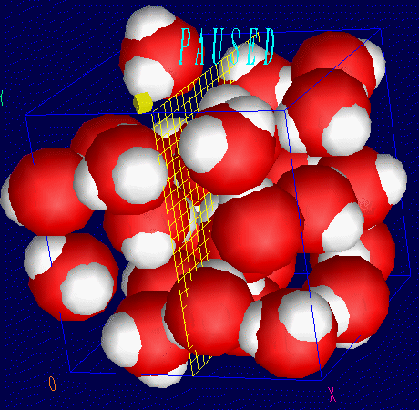
Virtual Molecular
Dynamics Laboratory. VMDL bridges the gap between the
microscopic and macroscopic through research-grade models,
curricula and workshops for high school teachers.
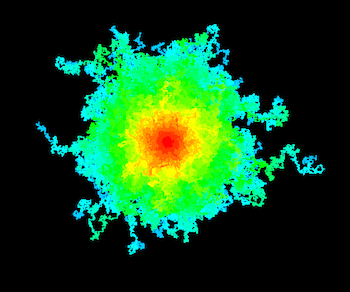
Patterns in
Nature. This modeling, curricula and workshop experience
helps students view understand the physical world through the lens of
fractal modeling and complex systems.
All CSSEL Projects
Student
Teaching and Outreach for the Graduate Program in Neuroscience.
Many of our efforts in developing educational programs in neuroscience
through CELEST are being applied to the Boston University wide programs
in neuroscience. Specifically, efforts are aimed at providing outreach
opportunities to Boston University's neuroscience students as well as
developing scalable educational programs that can be used in schools.
CELEST
Education developed neuroscience experiments, models, and
curriculum and bringing these results into schools. For four
consecutive years we hosted 2-week workshops for high school and undergraduate teachers
from across the country as well as other summer and academic year
programs for high school students, undergraduate students, and
teachers. See the CELEST Education
Summer Workshop Images from 2007.
VMDL Workshops for High
School Teachers. Our workshop page was initially funded to
support teacher workshops using the Virtual Molecular Dynamics
Laboratory. This teacher enhancement project hosted 2 week summer
workshops and 3-day academic year workshops for 336 high school science
and mathematics teachers. We also continue to host a broad range of
workshops as part of specific school or district initiatives, and this
is reflected on our broader page Complex Systems Science Education
Workshops.
The Virtual Molecular
Dynamics
Laboratory. This instructional materials development project is
based on the WAMNET pilot project. We have produced
curriculum materials (software and activities) that bridge the gap
between the microscopic and macroscopic.
GK-12: A Blueprint for Integration of High School & Middle
School Science and Mathematics. This project involved 20 graduate
and undergraduate science students (as well as a number of faculty) in
K-12 public education at several Boston-area schools including
Chelsea, Boston, and Cambridge. Hallmarks of the effort include
designing a new lab-based biology program in Cambridge, incorporating
physical science experiments into Chelsea middle schools, and creation of an
AP computer science course in Brookline and Chelsea. This project has since
merged with the other BU GK-12 project as a Track II titled Project
STAMP. See our Boston University
GK-12 Pages.
Teacher-Researcher
Collaboration in Scientific Modeling: The High School Science Virtual
Machine Laboratory. This Collaborative Research and Learning
Technologies project explored scientific modeling using distributed
computing, and made curriculum materials available via the
.
This instructional materials development project completed the
textbook Patterns in Nature: A New Approach to Interdisciplinary
Science which contains software, hands-on activities, and
experiments and is available at: Exploring Patterns in
Nature.
Patterns in Nature: A New Approach
to Interdisciplinary Science Teaching. Summer workshops during
1994, 1995, and 1996 for 160 high school science teachers using materials
developed at the CSSEL. Student activity
guides were developed by participating teachers.
The Dance of Chance: Growing Order
Out of Randomness. An interactive multimedia exhibit now on
display at the Boston Museum of Science and is available through our
online museum exhibit.
Visual and Interactive Modes for
Integrated Learning of Science and Mathematics. This
NSF Research on Teaching and Learning project explored areas of
impact on the WAMNET and OGAF projects.
Learning Science Through
Guided Discovery: Liquid Water and Molecular Networks (WAMNET).
This applications of advanced technology project has developed a number
of molecular dynamics simulation
programs and activities.